
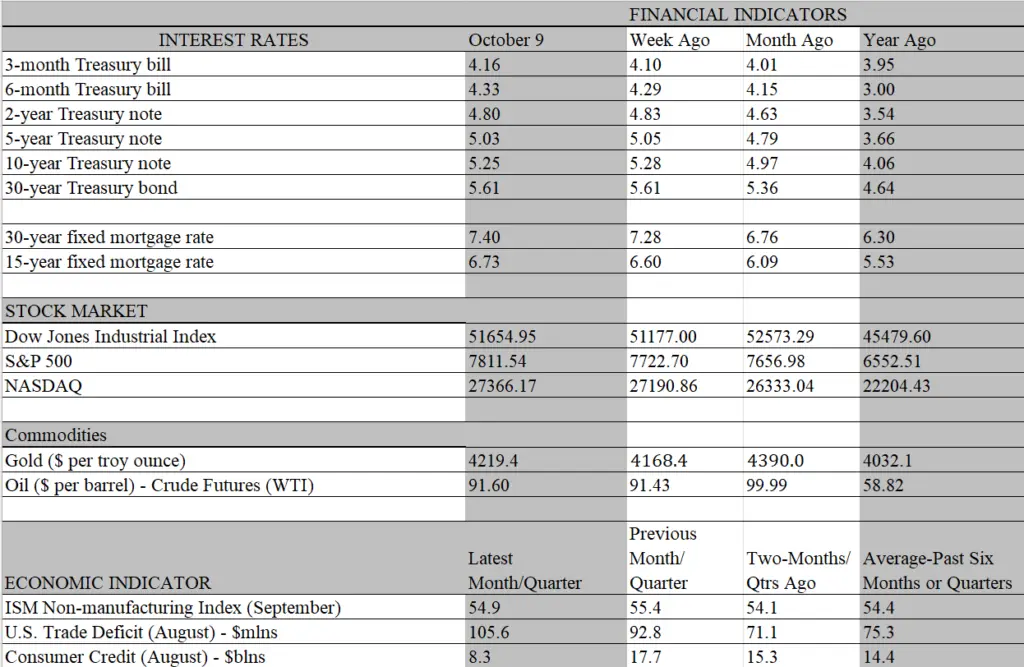
The dearth of headline-grabbing economic data this week did not stop speculation over what the Federal Reserve will do at its upcoming policy meeting on October 28-29. After the September confab, the consensus view was that a rate hike was a virtual certainty, both in October and at the December meeting. Fed Chair Kevin Warsh conveyed a surprisingly hawkish message at the news conference following that meeting, inferring that financial conditions were not restrictive enough to cool inflation amid an economy that is more resilient than expected. The quarter-percentage point rate increase taken at the meeting was considered nothing more than “removing a dose of accommodation” suggesting that more hikes were on the way.
Fast forward to today, and the view that more hikes are coming has not changed, but the financial markets have lowered the odds of a hike in October. Warsh has not commented publicly about possible moves, but other Fed officials were more open about expressing their views. Virtually all of them still believe that more rate increases are needed but are less adamant about an October hike. One reason is that incoming data since the September policy meeting lessened the urgency for a rate increase. The Fed’s preferred inflation gauge, the personal consumption deflator, was less inflammatory than expected in August, and the September jobs report, released last week, was hardly a barnburner; the unemployment rate edged up a tick, wage increases slowed and fewer payrolls were generated than expected in September following sharp downward revisions to job growth in July and August.
Keep in mind too that the Fed does not want to be accused of meddling in politics and the October policy meeting comes less than a week before the midterm elections. Taking all these things into consideration plus the more dovish recent comments from Fed officials, it is not surprising that the markets have priced in lower odds of a rate hike this month. Such a reset is entirely understandable in our view, but it would be a mistake to take a rate hike completely off the table later this month. For one, the softer than expected inflation reading in the deflator for August mostly reflected methodological changes in the way it is constructed, lowering the inflationary influence of portfolio management fees, for example, which had been closely linked to a booming stock market instead of the prices on things most consumers purchase.
Hence, next week’s release of the consumer price index might have more of an influence on the Fed’s decision as well as the upcoming retail sales report for September. If these reports continue to reveal hotter inflation and consumer spending, the Fed might be inclined to pull the rate hiking trigger instead of waiting and risk being accused of falling behind the curve. Another incentive is that external shocks boosting inflation keep on coming. The expanded Houthis attacks on Saudi Arabia this week signals no letup in the Mideast conflict, which is keeping pressure under oil prices as well as inflationary expectations. It has become harder for the Fed to look through these shocks as one-off events that can be ignored, as the more frequently they occur, the deeper the impression they leave on expectations.
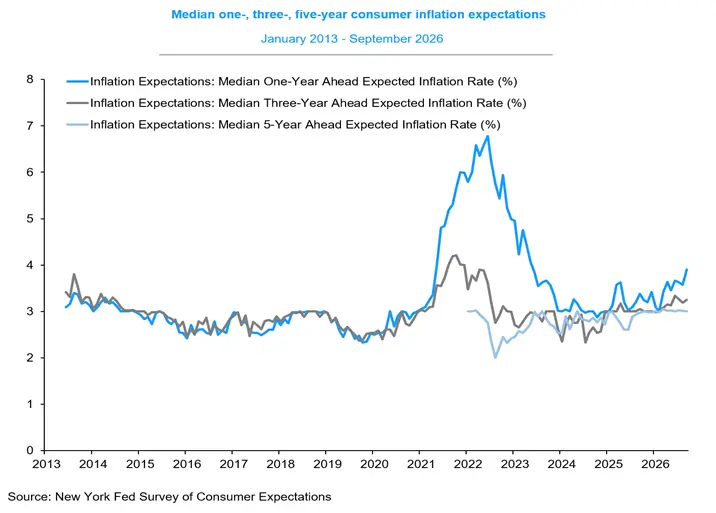
Indeed, the latest University of Michigan Sentiment Survey released on Friday showed that both short and long term inflationary expectations ticked up in early October, something that the Federal Reserve closely monitors and is clearly impacted by the war-induced elevation in gasoline prices. This follows a similar pattern in the New York Federal Reserve’s Survey of Consumer Expectations, which revealed a jump in expected inflation over the next year from 3.3 percent to 3.9 percent in September, the highest since May 2023. Unsurprisingly, higher expected and actual inflation are exacerbating affordability concerns among consumers, resulting in another drop in the UOM sentiment index. Households are more downbeat now than they were during the 2008 Great Financial Crisis as both inflation and sharply rising borrowing costs are taking an increasing toll on incomes.
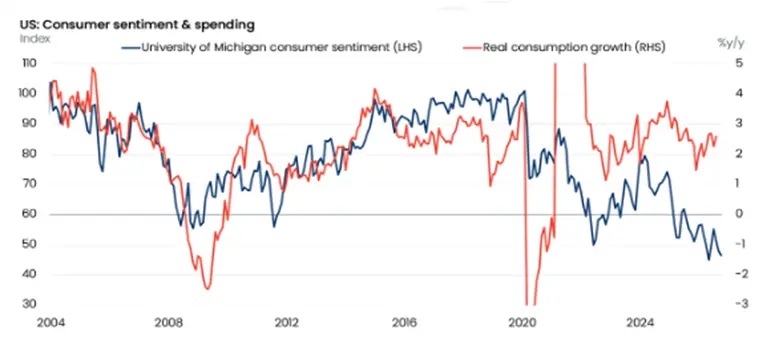
That said, there is also a growing disconnect between household feelings and behavior. Since the pandemic the gap between the two has widened dramatically, as consumer spending has been resilient even as perceptions about the economy has deteriorated. As much as anything, this growing disconnect is the mirror image of the bifurcated economy that has been taking shape over the past several years. Simply put, the spending prowess has been fueled by ballooning stock market wealth that is juicing the purchasing power and spending proclivities of affluent households. Even throughout the Mideast war, higher gasoline prices and spiking interest rates, the stock market has held up, hitting new highs this week. With the wallets of wealthier consumers wide open, discretionary purchases for big ticket items and expensive services remain strong even as budget constrained lower income households struggle to afford essentials, i.e., groceries, rent, heating bills and gasoline needed to fill up their cars to drive to work.
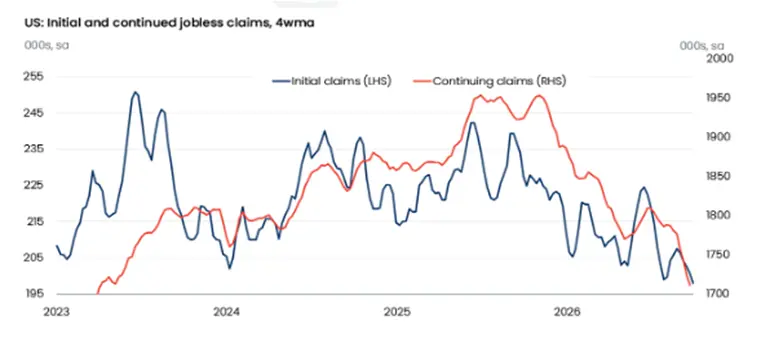
Fortunately, most of the less wealthy cohort can get by thanks primarily to their ability to hold on to their jobs. While job growth is slowing, as noted earlier, fewer applicants are looking for work due to an aging population and reduced immigration. Hence, the number of new hires needed to keep the unemployment rate from rising is also much lower than before. The 29 thousand increase in payrolls last month is quite small compared to recent years but it is about equal to the growth in the working age population and, hence, enough to sustain a balanced labor market. Meanwhile, the shrinking pool of available labor together with robust profits both encourage and enable employers to hold on to existing workers. With layoffs hovering near historic lows, state unemployment offices are seeing very few unemployed workers seeking jobless benefits. Over the last four weeks, the average number of initial claims for such benefits has fallen to the lowest level since the torrid job market in 2022-23, when the economy was surging out of the covid-induced recession and companies were facing a severe labor shortage.
The low hiring, low firing backdrop in the labor market is not expected to unravel anytime soon, and as long as the economy remains close to full employment the Federal Reserve has the flexibility to probe a higher level of rates to tamp down inflationary pressures. No one knows what the breaking point for the economy would be. However, since the external shocks mostly responsible for driving up inflation – wars and tariffs – over the past year are not susceptible to higher interest rates, the Fed might feel compelled to step harder on the brakes to stifle activity in the more interest rate sensitive sectors of the economy. Up to now, the biggest driver of economic growth, the AI buildout, has not been deterred by higher rates. But that could change as the borrowing needs to finance AI-linked investment spending are surging and at some point interest expense could become a deterrent. Should AI spending falter, so too could the stock market and the wealth effect that is propping up consumer spending. That inflection point is still a ways off; but as the Fed – and the bond market – pushes rates higher, the risks to the economy will increase.