
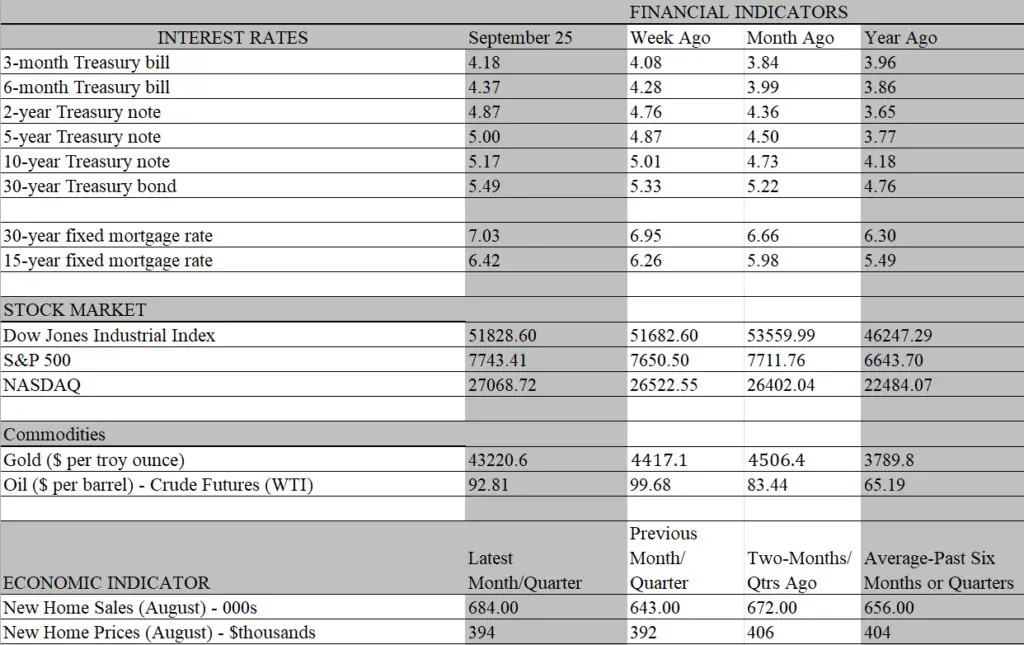
Despite headline-grabbing headwinds, there is no quit in the U.S. economy – at least not yet. We will get a better sense of how consumers are holding up next week, when the comprehensive personal income and spending report for August is released. But by all accounts households are keeping their wallets wide open, as indicated by the strong retail sales reported last week. Retail sales are mostly for goods but there is no reason to believe that spending on services faltered. Service providers derive most of their revenues from affluent consumers who are less affected by the headwinds impairing the purchasing power of lower income households.
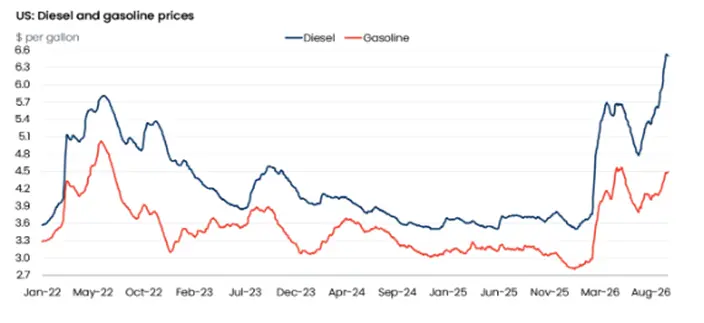
However, in a world of recurring external shocks, August seems like a lifetime ago. So far in September, the headwinds are turning into a gale force. The war in Iran continues to rage, crimping oil supplies and sending the average price of gasoline in the U.S. up to $4.50 a gallon from under $3 at the start of the year. Diesel prices have risen even faster and higher, raising the cost of farming and transporting food to groceries. Higher energy and food prices take a bigger toll on the budgets of lower income than for wealthier households. Meanwhile, the Fed has embarked on a rate hiking cycle to cool inflation, which the financial markets are betting will continue at least through the middle of next year, pricing in as many as four more increases. The toxic mix of elevated inflation and a hawkish Fed policy is sending bond yields to levels not seen in more than twenty years and mortgage rates to over 7 percent.
Unsurprisingly, all of this is adding to the downbeat mood of households. The widely followed survey of household sentiment by the University of Michigan revealed another 7 point drop in the overall index in September. The level of gloom is the lowest since the survey began in the late 1970s, plumbing depths deeper than during the 2007 global financial crisis and the dot.com bust early this century. What’s more, lowered expectations are driving the decline; perceptions of current conditions are also weakening, but less so largely because the job market is relatively healthy. We shall see if that perception is justified when the employment report for September is released next Friday.
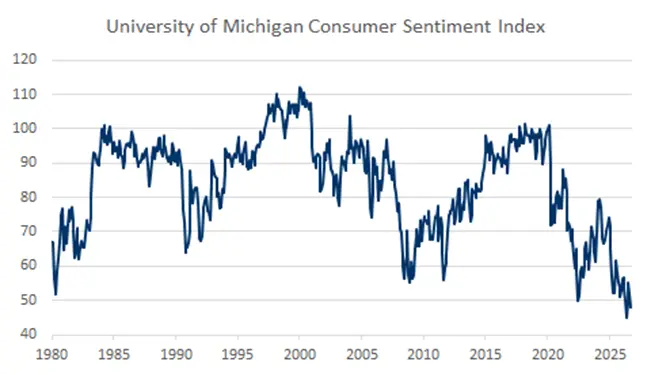
But the survey merely confirms a well-known fact, namely that people don’t always act as they feel. This so-called vibe-recession does not align with incoming data that portrays a highly functioning, robust economy, one that may even be heating up. Indeed, even the pollsters taking the survey noted that plans to buy big-ticket, durable goods, has picked up. But that too is not an uplifting outcome because it is based on higher inflation expectations. Respondents say that making such purchases now would help them avoid higher prices in the future. If this buy-in-advance attitude gains momentum, it would make the Fed’s job of cooling inflation more difficult and risky, as it heightens the risk of overreacting to a temporary influence that would fade on its own.
From our lens, wealthier households are the major source of strength behind consumer spending as they continue to benefit from appreciating stock portfolios and are less constrained by higher prices and interest rates. This wealth effect is alive and well. Despite all the negative headlines about inflation, interest rates and geopolitics, the stock market has barely wavered over the summer. Barring a major correction over the last three trading days of September, the S&P 500 will end the quarter higher than it was at the end of the second quarter, when financial wealth jumped to 280 percent of household income, a record high and nearly double where it was at the peak of the dot.com bubble.
Clearly, the AI buildout is juicing stock prices even as it is a major driver of the economy’s growth engine. The danger is that if one falters, the other will too. The public and political backlash towards data center construction is growing and higher interest rates are increasing the cost of the massive volume of borrowing these AI companies are undertaking. So far, however, these hurdles have not impeded their spending. New business orders for nondefense capital equipment excluding aircraft rose by a stronger than expected 1.6 percent in August, and a big chunk of that was for tech-related goods. Shipments also staged a solid gain, and this is a proxy for current spending. Hence, we expect investment spending to once again contribute mightily to the third quarter’s GDP growth rate.
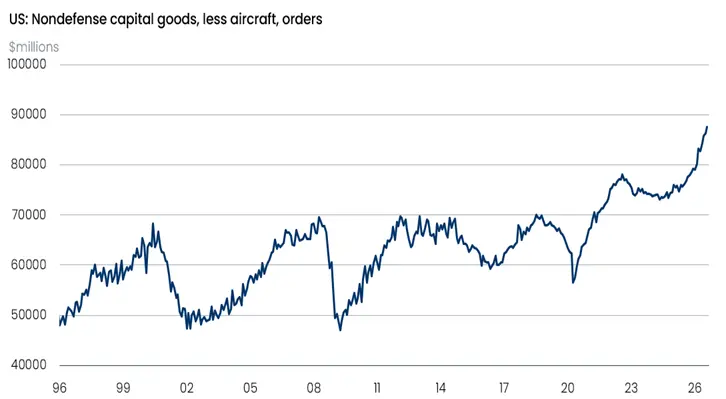
Importantly, there is no sign that capital spending will slow down in the foreseeable future. Despite emerging downside risks to business investment from higher energy prices and long-term interest rates, several factors will keep equipment spending in the fast lane. Corporate profit margins are at all-time highs; corporate bond spreads remain narrow; and last year’s fiscal package has raised the after-tax return on qualified capital investments. What’s more, business inventories are lean, meaning that any increase in demand for capital goods will feed through immediately to manufacturing orders and production. As it is, inventory rebuilding is another factor that will augment the economy’s growth rate in the third quarter, which is on track to exceed 4 percent, more than double the pace of the first half of the year.
The Federal Reserve next meets on October 27-28, and the markets are pricing in a 100 percent chance that it will hike rates by another quarter percentage point, lifting the federal funds rate to a range of 4.to 4.25 percent. Market yields have already adjusted to that expectation as well as to expected future increases, so they may not be significantly affected by the decision. However, if the Middle East war is still raging (even Trump admits that it may not be resolved until after the elections), energy prices will still be elevated and taking a bigger bite out of household budgets. We don’t believe that will be a deal breaker for the economy. We caution, however, that the only time a recession was avoided when the Fed hiked rates to cool off an energy-induced inflation shock was in 2022, when the economy was being juiced by over $2 trillion in government stimulus payments, With Washington running a $2 trillion deficit, there is little appetite in Congress to provide such relief now.