
It’s party time for Fed watchers, as policymakers are expected to add more punch to the bowl this coming week. Following a ten-month abstention, officials are likely to resume the rate-cutting campaign that included a full percentage point reduction over the final three meetings of last year, kicked off by a half point haircut in September. There is some speculation that another half point reduction would again kick start the upcoming easing cycle; but betters are placing greater odds of a traditional quarter-point cut, followed by two more over the final two meetings of the year. That would replicate the timing but inject less punch than last year.
The financial markets are celebrating the expected Fed move, as stocks staged another robust gain this week. For high-income individuals who are the biggest holders of financial assets, the reason to celebrate is just as obvious. For most residents on Main Street, however, the cause for joy is far less evident, given the ambiguous circumstances surrounding the Fed’s expected move. Indeed, the Fed itself is no doubt ambivalent about easing restraints on an economic party before the inflationary embers have been extinguished. That said, it sees more of a risk of a labor market meltdown than a sustained inflation flareup. While both prospects are unnerving, the Fed feels it is better equipped to wring out inflation than arrest a freefall in employment. The success in bringing the post- pandemic inflation cycle under control while keeping the economy afloat bolsters that conviction.
Still, this week’s data suggests that the final chapter to the inflation story has yet to be written. On the positive side, the impact of tariffs on prices has been less pronounced than feared. That’s partly because corporations, sitting on healthy profit margins, are willing to absorb the higher input costs for a while rather than risk losing price-sensitive customers. But it’s also because the normal lags between when tariffs are collected and when they hit consumers have yet to play out. Many of the more costly imported goods are still in inventory and will carry higher price tags as they are sold. How much of the tariffs will be passed on to consumers is still unclear. The impact will become more visible in coming months, but the Fed believes that it will lead to a temporary increase in the price level, not to a sustained increase in inflation.
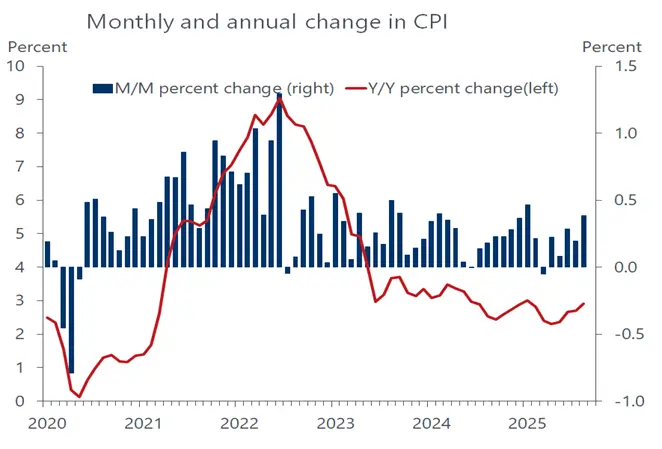
The August increase in the consumer price index captures that narrative. Overall prices rose a touch faster than expected, as the CPI rose 0.4 percent during the month, double the July increase and the strongest since January. Compared to a year ago, overall prices are up 3.1 percent, holding steady with the previous month. But excluding volatile food and energy prices, the trend is a bit more disturbing. The year-over-year increase in the core CPI accelerated to 2.9 percent from 2.7 percent in July and is increasing at an annual rate of 3.6 percent over the past three months. While the impact from tariffs has been limited, prices on goods most exposed to the levies are showing the fastest increase. Grocery prices staged the largest increase in three years, and big increases were reported for autos and apparel.
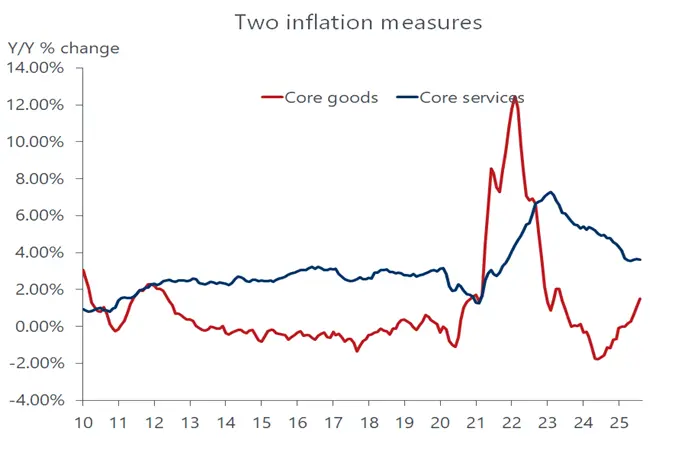
Overall, core goods prices, which are more exposed to tariffs than services, have been steadily climbing since liberation day tariffs were announced in April. In August, they stood 1.5 percent higher than a year ago. That does not seem like much, but in the 15 months leading up to April these prices had been declining. Importantly, the decline in service inflation had been offsetting the reacceleration in goods prices. That’s no longer the case, as the declining trend for services has leveled off in recent months. At best, sticky inflation will slow the Fed’s easing campaign. At worst, tariffs will lift the inflation trend and seriously crimp the Fed’s efforts to shore up a sagging job market.
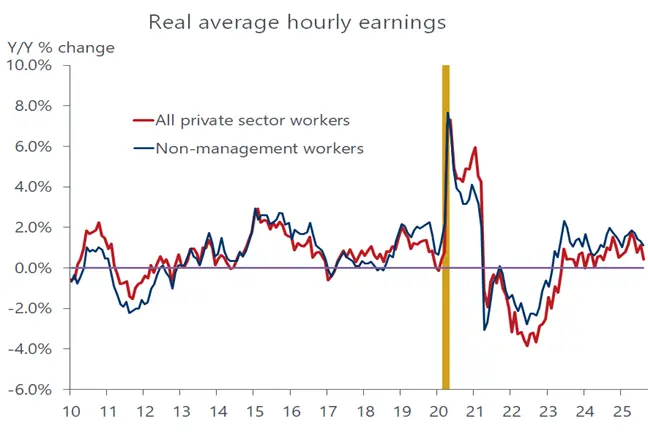
We believe that inflation will be more sticky than hot and allow the Fed to gradually normalize policy over the next year. While tariffs are clearly a source of price pressure, budget-constrained consumers will limit the pricing power of businesses. As it is, the warming inflation trend is eating into household purchasing power. Worker earnings are still rising at a decent pace, but they are now falling behind the increase in inflation. As recently as this spring, workers in the private sector were getting real annual wage increases of 1.44 percent; in August, that increase had slimmed down to 0.7 percent, erasing all the gains over the past year. With job growth slowing, if not stalling out, worker bargaining power is eroding and the squeeze on purchasing power will likely become more intense in coming months.
Since lower-income households spend more of their incomes on tariff-sensitive goods than wealthier households, they will feel the brunt of the squeeze. Unsurprisingly, the latest University of Michigan survey of households revealed that sentiment in September was dragged down by growing pessimism among low and middle-income households, with tariffs dominating the responses. From the Fed’s standpoint, the mix of discontent afflicting households could not be more worrisome. They not only fret over higher prices – long-term inflation expectations spiked 0.4 percent to 3.9 percent – anxiety over job losses also jumped.
To be sure, the connection between household expectations and actual behavior is loose, and we do not expect consumers to zip up their wallets, something that would heighten recession prospects. For one, wealthier households are the biggest drivers of consumer spending, and this cohort continues to benefit from sizeable wealth gains, thanks to ongoing gains in stock and home prices. For another, most households – as well as businesses – will receive considerable fiscal support next year from tax and spending legislation embodied in the One Big Beautiful Bill Act passed this year. Finally, while tariffs have clearly been a disruptive force in the U.S. and global economy this year, a lot of it stemmed from the uncertainty they created. Not all is settled, of course, but there is more clarity on that front now. We expect the uncertainty over tariffs that has frozen business decisions this year to continue to fade and allow spending and hiring plans to move forward next year.