
Note: The weekly commentary will not be published over the Labor Day weekend. The next issue will be published on September 11.
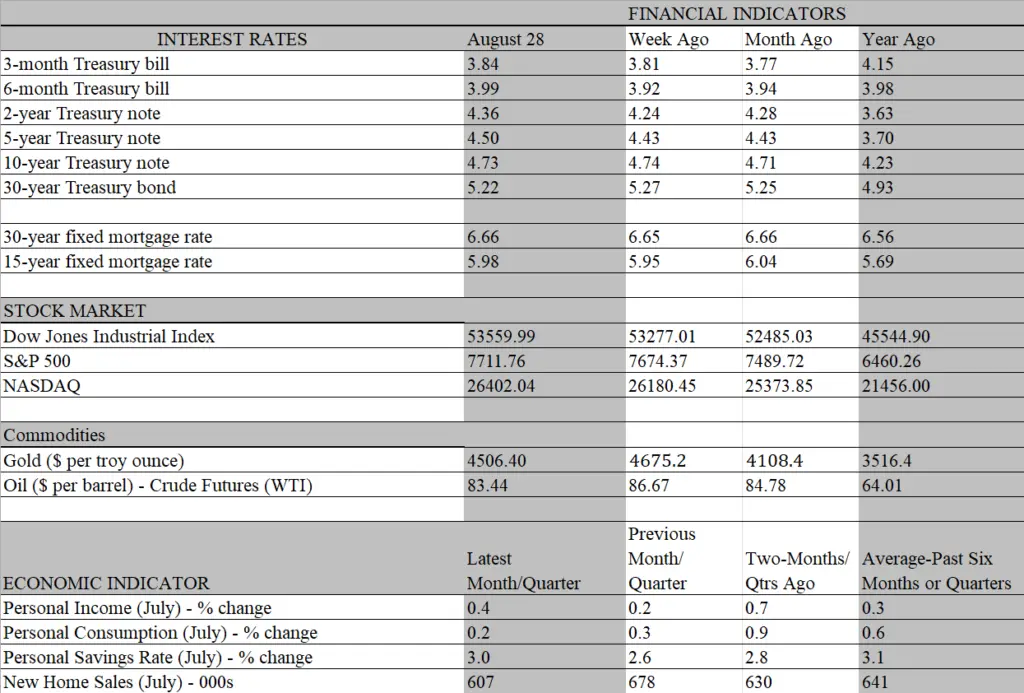
Fed Chair Warsh’s keynote address at the Jackson Hole Symposiam on Friday commanded most of the economic headlines this week. That said, the financial markets had plenty of other news to digest, including fresh data on consumer spending and inflation, and the Treasury’s continuing efforts to tame the rise in long-term interest rates. Regarding the latter, Secretary Bessent’s announcement last week that the Treasury plans to double its purchases of long-dated Government bonds failed to have a lasting impact. After a brief decline on the day of that announcement, yields quickly rebounded and erased most of the earlier decline. This week, Bessent indicated that the Treasury could further flex its muscle and use its formidable balance at the Fed to increase the size of the buybacks. That too failed to have a meaningful impact, as the bellwether 10-year Treasury yield returned to about where it was before the first announcement a week ago.
Simply put, traders are well aware that it is the economy, not short term fixes, that will determine the path of interest rates. Indeed, Bessent’s efforts to bring rates down was not helped by Warsh’s comments on Friday. The Fed Chair delivered a surprisingly more hawkish speech than expected, noting that he did not think financial conditions were unduly restrictive as the economy continues to perform quite well and most attention should be on getting inflation down to the 2 percent target. To market participants that constituted a strong signal the Fed is more likely to raise rates than had been thought. Unsurprisingly, the markets wasted no time following the speech to price in higher odds that the Fed would raise rates as soon as the next meeting in September. The CME FedWatch tool now puts those odds at 56% versus 35% on Thursday.
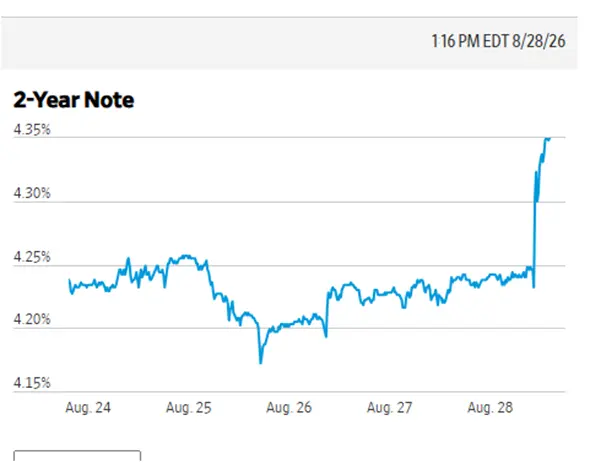
Importantly, the biggest response to Warsh’s speech was among shorter-term yields, notably on the 2-year Treasury note which is highly sensitive to Fed rate expectations. The dramatic climb in that yield is starkly revealed in the following chart. The rise in the 10-year yield was more moderate, reflecting Warsh’s reaffirmation of his commitment to lower inflation, which also enhanced the Fed’s credibility. Recall that there was much speculation after his appointment by President Trump as to whether he would accede to pressure from the White House to lower interest rates, something that would clearly undermine the Fed’s independence and credibility. Warsh’s public comments during his brief time at the helm, including Friday’s, would seem to put those concerns to rest.
But Warsh, unlike his predecessors, did not provide any thoughts as to how the economy will perform, nor how the Fed would react under varying economic circumstances, the so-called reaction function. That reluctance is not surprising, as it simply confirms his earlier comments that the Fed should not get locked into forecasts based on stale data or influence market expectations by providing forward guidance. He would prefer to let the data do the talking and the markets draw their own conclusions. No doubt, the latest data released this week reinforced the market reaction to Warsh’s hawkish comments, as inflation showed very little sign of easing.
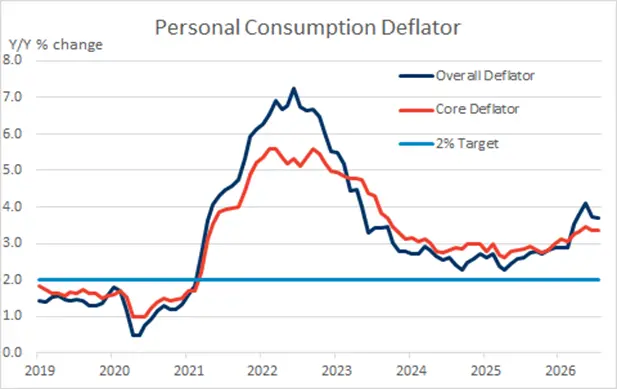
Indeed, the two versions of the Personal Consumption deflator, the Fed’s preferred inflation gauge, did not budge from the previous month in July. The overall PCE increased 3.7 percent from a year ago, while the core deflator, that excludes volatile energy and food prices, increased by 3.3 percent. Both equaled the annual increases seen in June, and both remained firmly above the Fed’s 2 percent target. Inflation has exceeded 2 percent for more than five years, and it’s unclear how much longer the Fed will wait before it moves decisively towards the target. The next policy meeting is scheduled for mid-September, and there will be one more round of inflation reports before then. One thing Warsh did make clear in his speech: adjustments to short term interest rates will be the primary tool used to bring inflation down.
The question that needs to be answered, however, is how committed to lowering inflation will the Fed be if the economy starts to sputter or, more importantly, the job market takes a sudden turn for the worse. Remember, the Fed has a dual mandate, maintaining price stability as well as full employment. Warsh played down concerns about the other half of the Fed’s mandate, arguing that the labor market and broader economy remain resilient, and that softer jobs growth this year reflects weakening labor supply instead of weakening demand. That’s more sanguine than our view that labor demand remains fragile, and that a slowdown in economic activity would likely trigger a renewed rise in unemployment.
Through the first half of this year, there is little question that the economy has been resilient, buoyed by AI investment spending (which Warsh devoted much of his speech to) as well solid consumer spending. However, there are growing doubts as to whether consumers will continue to keep their wallets open as wide, as the support from above-average tax refunds this spring wanes and wage growth continues to slow. Signs of fatigue may already be showing up. Following a solid increase in spending during the second quarter, this week’s personal income and spending report revealed a marked slowdown in July following a softer read in June, the first back-to-back slowing in over a year.
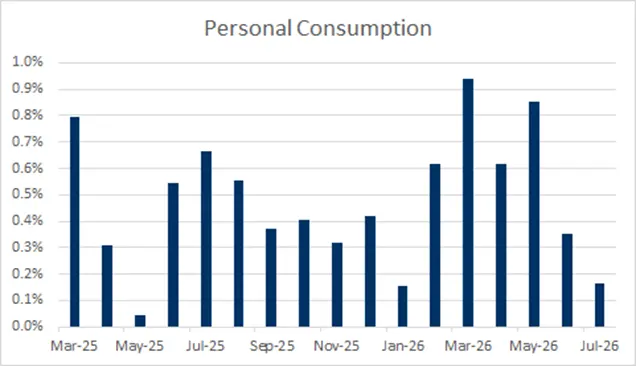
To be sure, household incomes rose more than spending for a change in July, but with job growth slowing, energy prices taking an ever bigger bite out of budgets and confidence surveys revealing a recession-level mindset among households, more of the income is being set aside into savings. The personal savings rate ticked up to 3.0 percent in July from 2.7 percent, but that is still well below normal levels and some further buildup in precautionary savings should be expected. Whether or not, this prospect prompts the Fed to hold off on a rate increase in September remains to be seen. The next report on personal consumption will not be available until after the mid-September meeting. However, a fresh jobs report for August will be released before then, and that could have a major influence on any rate setting decision. We suspect that if it comes in much softer than expected, the Fed will stay on the sidelines and wait to see more evidence of economic weakness. A critical wildcard, of course, is the Mid-east war and its oil-induced impact on inflation. The longer it persists, the stronger will be the impact.