
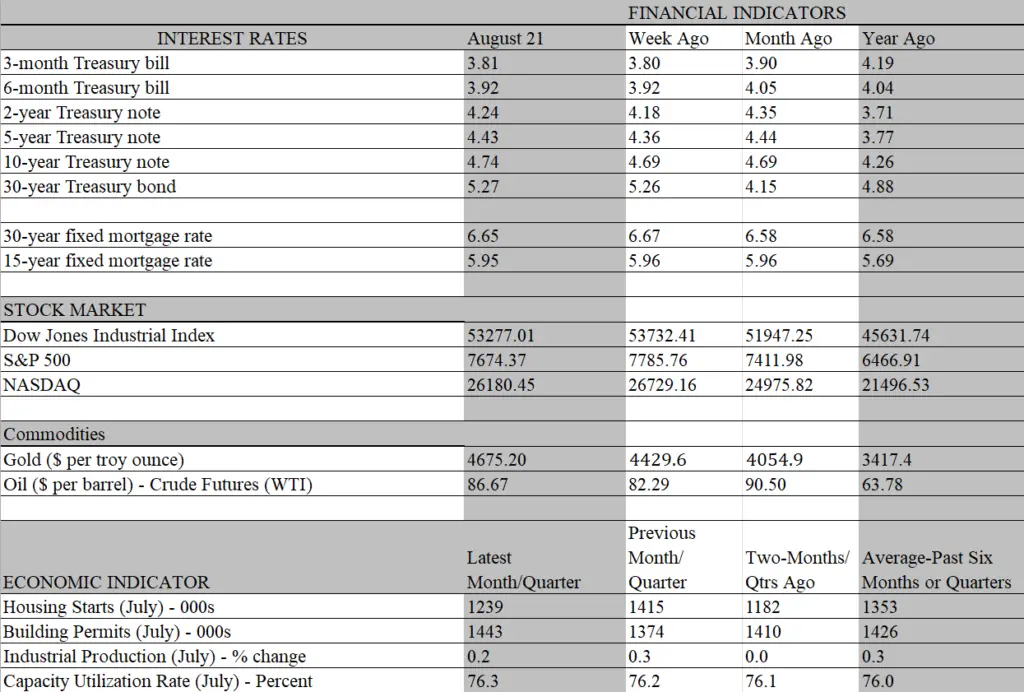
All eyes will be focused on the Jackson Hole Symposium in Wyoming next week, a gathering of the world’s leading central bankers where Fed Chair Warsh will be the featured speaker. It’s doubtful, however, that he will be any more transparent about policy intentions than he has shown so far in his brief time in office. Warsh is not a fan of providing forward guidance but would rather have the data do the talking and let the financial markets judge what should be the appropriate response. But while Warsh may be reticent, other Fed officials are making their voices heard. According to the minutes of the July policy meeting released this week, more of them would like to hike rates than indicated in the post-meeting summary statement or in the chairman’s press conference shortly thereafter.
That sentiment was dramatically echoed in the financial markets this week, as traders sent yields, particularly on long-term securities, to their highest levels in two decades. But the yield climb did not occur entirely for the same reason that the more hawkish Fed officials were advocating. These policymakers were mostly concerned over sticky inflation, which has remained above the Fed’s 2 percent target for five years, and think that higher rates were necessary to finally bring it under control. Some believed that rates should be raised immediately, while others were willing to wait a while but would pull the trigger later this year if inflation did not come down. At the time of the late July meeting, the economy and labor market seemed strong enough to withstand higher rates.
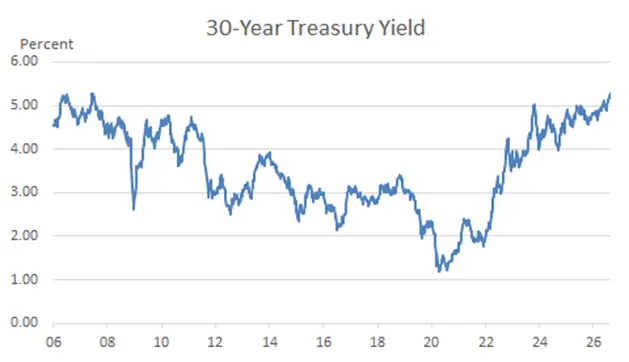
However, the bond vigilantes had more on their minds than just inflation for sending rates higher. Indeed, market pricing of long-term inflation expectations has remained relatively stable. What traders are more concerned about is the surge in debt issuance from both the government and corporations, growing uncertainty over geopolitical events (e.g. the Iran war) and the lack of clarity over Fed policy, which adds to market volatility and, hence, a higher risk premium built into yields. All of these catalysts were on full display this week, including the headline-grabbing notice that U.S. government debt reached an eye-opening $40 trillion for the first time.
To be sure, there is no magic number as to what the breaking point is for government debt. Not too long ago, it was thought that if the nation’s publicly held debt exceeded 90 percent of GDP, catastrophe would follow. We passed that threshold during the pandemic and are poised to pierce 100 percent of GDP again this year, yet the economy is still standing and growing. But the current landscape is problematic in a number of ways that are different from past periods of rising debt and deficit financing.
Historically, government borrowing rises more rapidly when the economy is struggling and in need of fiscal stimulus to regain its footing. The opening of the fiscal spigot, in turn, is not disruptive because the private sector is retrenching, pulling back on spending and borrowing, which leaves more space for new government debt. That’s not the case now. Not only is the economy expanding, but the private sector, led by the AI buildout, is borrowing heavily, competing with the government for capital market funds. Indeed, the surge in AI-related borrowing has led to a $1.5 trillion increase in investment grade debt so far this year, 36 percent more than last year according to Bloomberg estimates. That’s a lot of supply coming when the Treasury’s deficit financing needs is expected to hit a record $2 trillion this year.
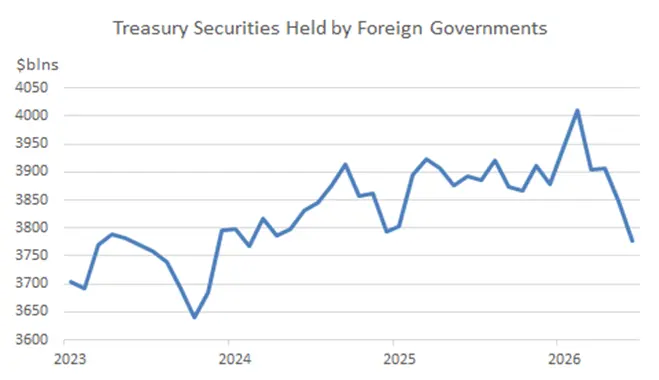
Importantly, the bulge in supply of new debt is facing a less hospitable group of investors. Typically, a big chunk of demand for Treasury securities comes from pension funds and foreign governments who seek out predictable assets and are not sensitive to interest rate changes. But for a variety of reasons, this stable source of funds is diminishing; that’s particularly the case among foreign official institutions, which have been unloading U.S. Treasury holdings by the boatload this year. Simple math tells you what happens when increased supply meets reduced demand: for bonds, prices go down and yields go up. Unsurprisingly, the government’s latest quarterly auction of 10 and 20 year securities met with tepid bidding, resulting in higher yields.
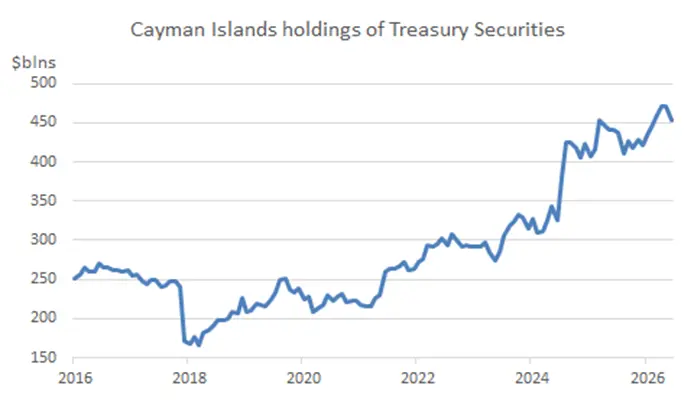
To be sure, the Treasury was able to find buyers for its securities, even if it had to pay up to satisfy demand. But the buyers taking up the slack have a much different profile than foreign governments. Much of the slack is taken up by hedge funds and other private institutions who, for tax and other purposes, set their official headquarters overseas, with the Cayman Islands a popular destination. As can be seen, Treasury holdings by that source has increased exponentially in recent years. The problem with this shift in ownership is that hedge funds and other private holders are much more yield sensitive than foreign governments and are prone to be more traders than stable investors. This matters because it exposes the Treasury market to more volatility as these investors jump from safe assets, such as Treasuries, when the environment seems risky, to higher yielding riskier securities when conditions are stable.
Clearly, the environment today could be viewed as risky, given the uncertainties surrounding the Iran war, monetary policy, and the struggles to get a burgeoning budget deficit under control. This week, Scott Bessent, the Treasury Secretary, tried to counteract the rise in bond yields, saying that the Treasury will double its planned buybacks of long-term government securities from $2 billion to $4 billion a quarter. That prospect, however, only provided a brief respite as the slide in yields on the day of that announcement was reversed the next day, underscoring the power of the bond vigilantes to offset a government – or Federal Reserve – policy that they believe is not aligned with economic fundamentals. What’s more, the Treasury’s attempt to lower yields conflicts with the growing sentiment within the Fed to tame inflation by keeping rates elevated, if not pushing them higher. It’s not the first time the Fed and Treasury has been at odds with each other, and it won’t be the last. But it does add another layer of tension into a market that is already engulfed in turmoil.